Real-time trip tracking
Real-time trip tracking that logs ~90% of pickups and deliveries with no human fix
Drivers were meant to log every pickup and delivery by hand, and most didn’t, so dispatchers spent hours a day working out when trucks arrived. I architected a real-time multi-agent system that rebuilds each truck’s day from the signals it already sends. When the evidence disagrees, it leaves the stop open for a dispatcher.
- Kind
- Production system, in daily use
- My role
- Architect and team lead, wrote the core logic
- Team
- Two engineers, daily code review
- Scale
- ~2,000–2,500 trucks on the road at once
- Built for
- Dispatch and operations; customer updates and billing read its timeline
- Techniques
- real-time, multi-agent, sensor fusion, event processing, human in the loop
Results
- of trip milestones logged with no human fix
- of dispatcher detective work saved every day
- trucks tracked live at once
Delivered within a prior employer’s environment. Details are intentionally anonymized. I’m glad to discuss the operating problem, design principles, and production tradeoffs.
The problem
Delivery windows decide whether we get paid, and about half of our reps’ calls to drivers were some version of “did you arrive?”
Make the feeds agree first.
Nine signals about where each truck is are reconciled into one stream before any model sees it.
The call
Give agents one trusted stream, so they decide about the stop instead of guessing about the data.
Techniques: sensor fusion, event processing
Let code find stops, and agents name them.
Code finds the stops. Agents decide what each one was and which milestone it fills.
The call
Use a model only where judgment is needed. Code is cheaper and gives the same answer every time.
Techniques: multi-agent, deterministic before generative
Keep the real day next to the plan.
Every stop stays on a true timeline, and only corroborated stops fill the planned milestones.
The call
A milestone closes only when independent evidence agrees, because a payment window depends on it.
Techniques: corroboration
Leave it open when the evidence disagrees.
The milestone goes to a dispatcher with the evidence attached.
The call
A confident wrong answer would bring back the disputes we were ending.
Techniques: abstention, human in the loop
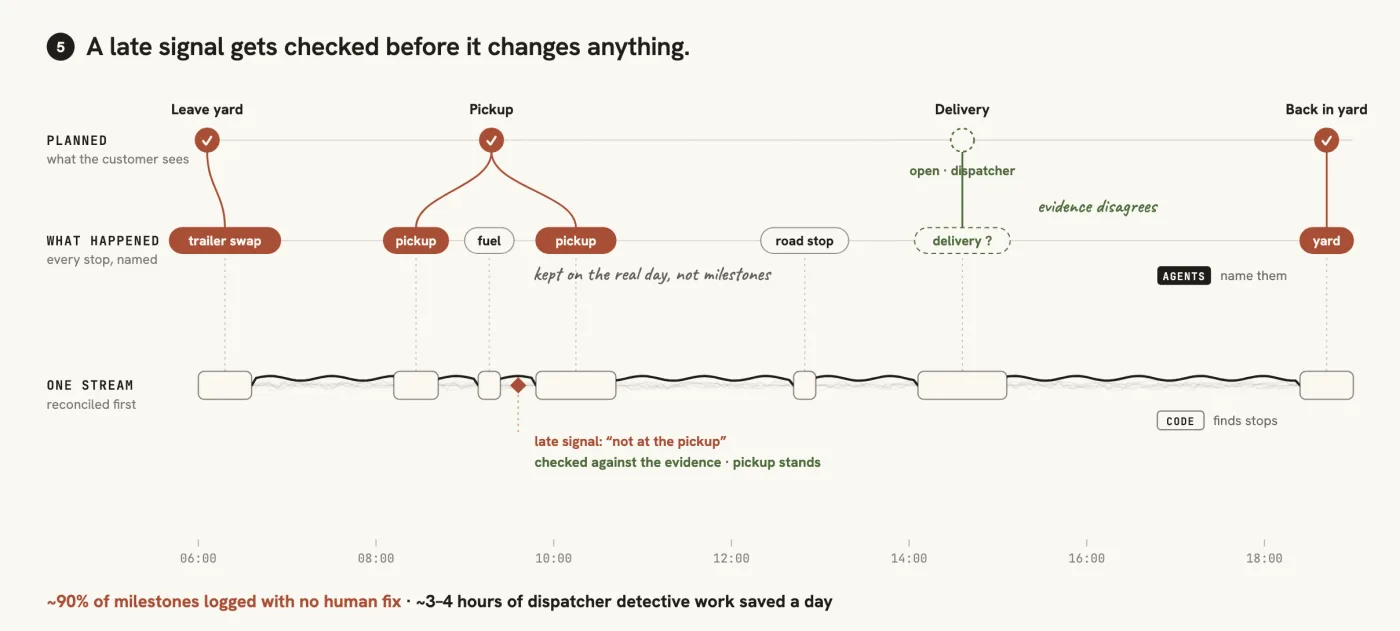
Check late signals before believing them.
A late contradiction can reopen a milestone, but only after it’s checked.
The call
The last signal to arrive doesn’t get to rewrite the day.
Techniques: late-arriving data
What fell short
What I tried
Logging every dispatcher approval and edit, per milestone.
What broke
It proved the ~90%, but not why a stop was edited, so we read edits by hand to find what to teach the agents next.
What changed
A reason on every correction.
In hindsight
Capture the why from day one.
Ask me about
- How nine signals that disagree become one stream
- What counts as enough evidence to close a milestone
- When a late signal is allowed to change history