Load recommendations
Load recommendations for ~1,000 trucks that dispatchers accepted two times in three
Dispatchers picked each driver’s next load one driver at a time, and nobody could see what a pick really cost. I built a model that ranks every open load for each driver, live on every lookup, and proposed an optimizer that plans every driver at once. Dispatchers accepted about two in three of its recommendations.
- Kind
- Production system, in daily use
- My role
- Framed the problem and owned the ranking model end to end
- Team
- Built the optimizer and simulator with a senior data scientist and a data analyst
- Scale
- ~1,000 trucks across Canada, ranked live on every lookup
- Built for
- Dispatchers choosing every driver’s next load
- Techniques
- learning to rank, feature engineering, real-time inference, MLOps, drift monitoring, simulation, optimization, human in the loop
Results
- optimizer recommendations accepted by dispatchers
- trucks, Canada-wide
- ranked live, in real time
- checked against dispatchers’ past picks
Delivered within a prior employer’s environment. Details are intentionally anonymized. I’m glad to discuss the operating problem, design principles, and production tradeoffs.
The problem
A pick that looks good on the board can hide empty miles, a missing trailer, or a driver stranded tomorrow. I split one tangled decision into four questions, each with the right tool.
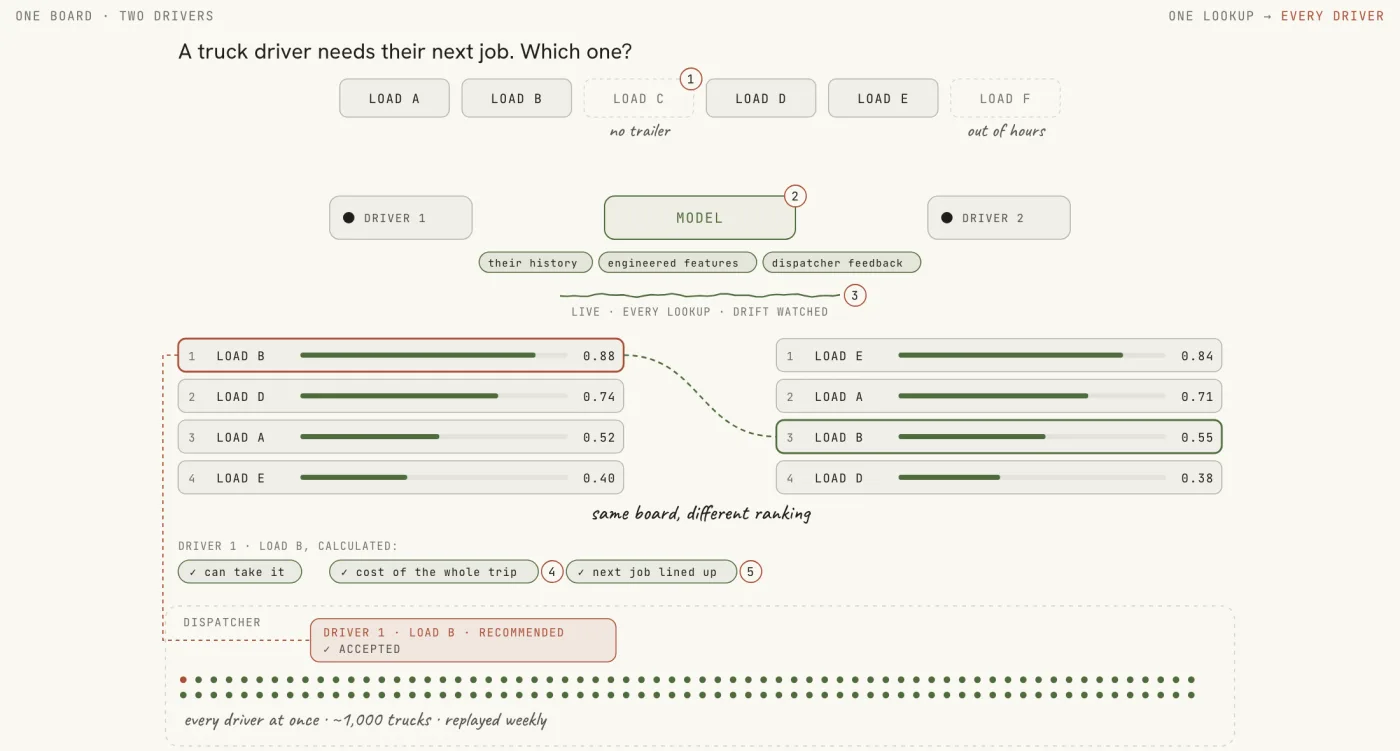
Rule out what can’t be taken.
Trailer, hours and time-window checks remove impossible loads first.
The call
What’s certain is a rule, so the model only ranks loads a dispatcher can act on.
Techniques: hard constraints
Rank what fits each driver.
A learning-to-rank model scores every driver and load as a pair, from features I engineered.
The call
Score fit only. Cost can be calculated, so we kept it out of the model.
Techniques: learning to rank, feature engineering, explainability
Watch it once it’s live.
Checked against dispatchers’ past picks before launch, then served on every lookup with drift watched.
The call
Only overrides with a reason the model should learn from go back into training.
Techniques: offline evaluation, real-time inference, drift monitoring
Cost the whole move.
A simulator plays each load forward, from the empty drive to where the driver ends up.
The call
Calculate what can be calculated, instead of asking a model to guess it.
Techniques: simulation
Plan every driver at once.
An optimizer picks the best assignment across the fleet, replayed every week.
The call
Choose for everyone together, so no two drivers chase the same load.
Techniques: fleet optimization
What fell short
What I tried
Planning around drivers first, and folding trailer inventory in later.
What broke
Trailers were still being added at the end, so the plan didn’t yet see every limit on the equipment.
What changed
The full trailer picture in the optimizer, then cross-border loads.
In hindsight
Bring trailers into the plan from the first version.
Ask me about
- Which features mattered most, and which surprised us
- How we kept the wrong overrides out of training
- Why the optimizer isn’t a model