Fuel-loss alerts
Fuel-loss alerts cut from 50% false to 15%, so analysts opened them again
Half the fuel-loss alerts I inherited were false, so our analysts had stopped opening them. I rebuilt the data underneath and the detection on top. False alerts went from ~50% to ~15%, and real losses started getting caught again, about $80–110K a year in Mexico alone.
- Kind
- Production system, in daily use
- My role
- Rebuilt the data pipeline, ran the model experiments and shipped the ensemble
- Scale
- ~2,500–3,000 trucks, readings every 1–2 minutes from three providers
- Built for
- Fuel analysts, who had stopped opening the old alerts
- Techniques
- anomaly detection, time series, sensor fusion, data quality, ensemble models, LLM assistant, human in the loop
Results
- → false alerts
- confirmed incidents in Mexico alone
- a year in losses surfaced, in one country
Delivered within a prior employer’s environment. Details are intentionally anonymized. I’m glad to discuss the operating problem, design principles, and production tradeoffs.
The problem
Fuel loss is quiet, a little at a time across thousands of trucks. With half the alerts false, analysts stopped trusting any of them.
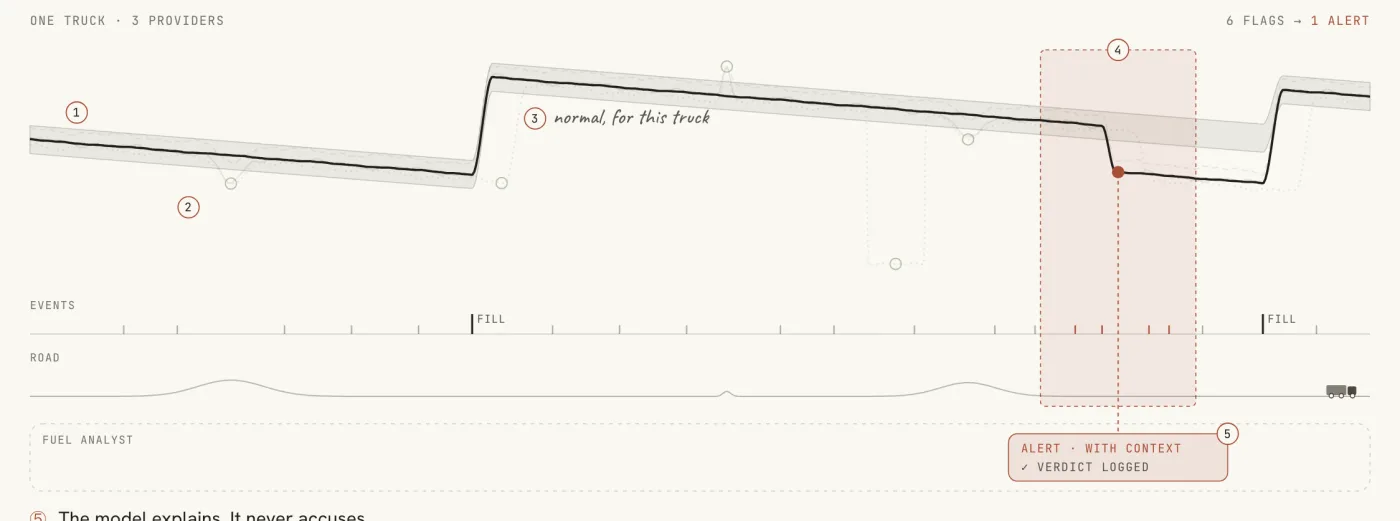
Make the three providers agree.
Three telematics providers reported the same tank differently. I reconciled them into one fuel level per truck.
The call
Fix the data before the model. No model can fix inputs that disagree.
Techniques: sensor fusion, data quality
Clean out slopes and bumps in code.
Tilts, bumps and sensor glitches are removed before detection runs.
The call
So when a model is wrong, it’s wrong about fuel.
Techniques: signal cleaning
Judge each truck against itself.
Each truck is compared with its own history.
The call
A fleet-wide threshold keeps flagging the same old tank, and that’s how analysts learn to ignore alerts.
Techniques: per-entity baselines, ensemble models
Send every alert with what happened around it.
Each alert shows the events either side of it.
The call
An analyst deciding whether to act needs to see what the truck was doing.
Techniques: explainability
Let the assistant explain, never flag.
An assistant answers analysts’ questions from the data.
The call
Detection stays with models we can check. The LLM helps a person think it through.
Techniques: LLM assistant, human in the loop
What broke first
What I tried
The alerts I inherited ran straight on raw sensor readings.
What broke
Every slope and bump looked like a loss. Half the alerts were false, and analysts stopped opening them.
What changed
Rebuild the data first, then the detection.
In hindsight
Measure what it misses, by regularly checking trucks it never flagged.
Ask me about
- How three providers that never matched became one fuel level
- What the ensemble looks at
- How I’d measure what the alerts miss