Customer email drafting
A customer email autopilot that drafts every reply from the shipment’s full history
Every wait cost us a little of a customer’s trust, and most of a reply went into digging through threads and shipments. I designed and built the system under our email autopilot that does the digging, so every draft starts from the shipment’s full history. About 70–80% of drafts went out without edits, and each email took 10–15 minutes less. A rep approves every reply.
- Kind
- Production system, in daily use
- My role
- My idea. I designed the system and built it with two engineers
- Scale
- ~5,000 emails a day across shared inboxes
- Built for
- Customer service reps across North America and Mexico
- Techniques
- agentic drafting, relational store, knowledge graph, RAG, entity resolution, intent and sentiment, routing, human in the loop
Results
- of drafts sent without edits, as the business reported it
- saved on every email
- emails a day across shared inboxes
- approved by a rep before it went out
Delivered within a prior employer’s environment. Details are intentionally anonymized. I’m glad to discuss the operating problem, design principles, and production tradeoffs.
The problem
For one reply, a rep had to find the shipment, read back through the thread, check what the driver sent, follow up, and often call. Writing was the quick part.
Pull every thread apart, and its identifiers out.
Every thread is split into its emails, and the shipment identifiers in each one are pulled out.
The call
Store it relationally, so everything about an email is one query away.
Techniques: relational model, identifier extraction
Find the shipment, then everything around it.
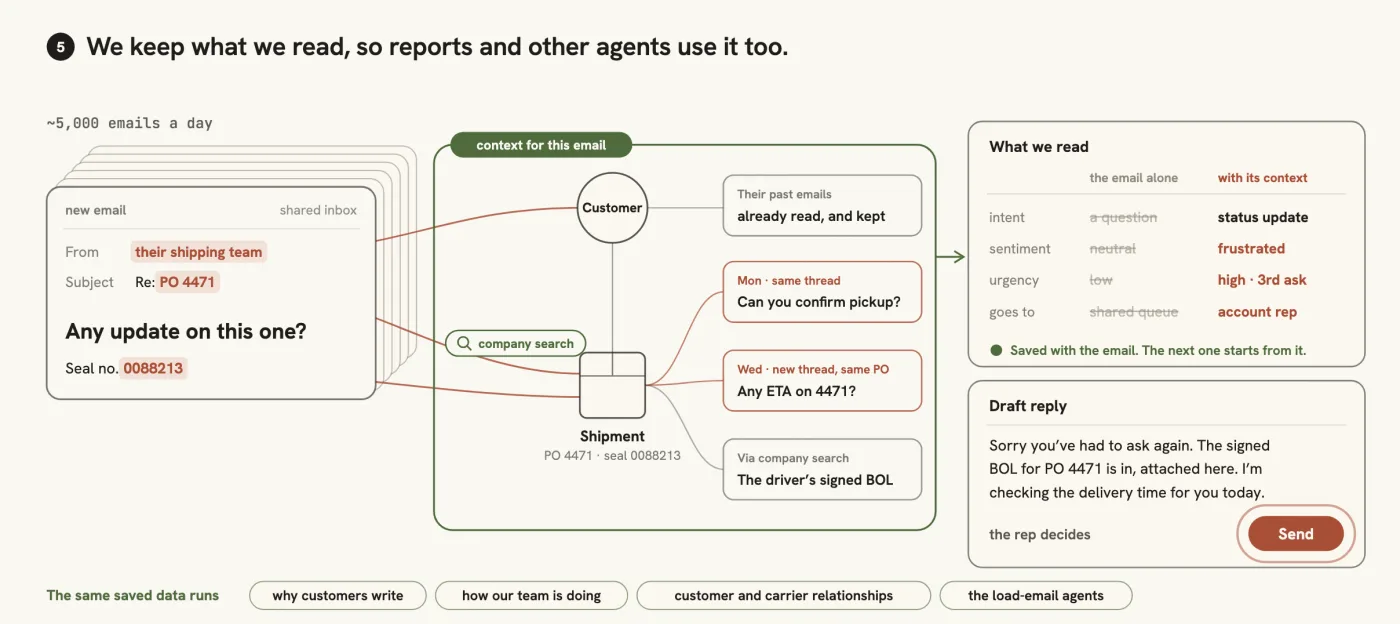
Company search turns identifiers into shipments, and from there into every related email and document.
The call
Reuse the knowledge graph and search from Document AI, instead of keeping a second copy of our entities.
Techniques: knowledge graph, RAG, entity resolution
Read it with that context, once.
Intent, sentiment, urgency and routing are worked out on the context and saved with the email.
The call
Judge urgency on the history. “Any update on this one?” looks calm, but as the third ask this week it’s urgent and goes to the account rep.
Techniques: intent and sentiment, routing
Draft, and let a rep decide.
The autopilot drafts from that context. A rep edits it and decides if it goes out.
The call
Nothing reaches a customer without a person. A wrong reply costs more trust than a slow one.
Techniques: agentic drafting, human in the loop
It became a base for more.
Reports on why customers write, how our team is doing and how each relationship is going all read the same data, and so did my teammates’ load-email agents.
The call
Compute once, read many. Every report and agent reads the same saved answer.
Techniques: reporting, platform for agents
What fell short
What I tried
Drafts built from the saved history and company search.
What broke
Follow-ups. A draft could say the paperwork was in, but not where the truck was.
What changed
Live shipment status in the draft. That was the next phase when I left.
In hindsight
Track edits on every draft from day one. The 70–80% came from the business’s view, and I’d rather have measured it draft by draft.
Ask me about
- How an email that never names its shipment still finds it
- How we counted urgency from the history
- How the 70–80% was judged, and how I’d measure it now